Game Night: Which Card or Party Game Suits Your Group?
Three players or ten, kids or grown-ups only, twenty minutes or a whole evening: here's how to find the card game that fits your group.
This article contains affiliate links (marked with *). If you buy through them, we earn a commission – the price stays the same for you. Learn more
Friends are coming over, the pizza’s ordered, and then the big question: what are we playing? A game that’s brilliant for two turns into a test of patience for eight. And the one that has your friends in stitches may overwhelm an eight-year-old or bore the grandparents. The good news: you don’t need a cupboard full of boxes. Once you know what matters for your group, two or three well-chosen games are enough. Let the lynx sort it out for you.
Four questions before you open a box
Before we get to specific titles, take a quick look at the group itself:
- How many of you are there? Many games only work within a certain range. The number on the box is more of an upper limit than a promise of the best experience.
- Who’s playing? Kids, adults, a mix? The manufacturer’s age rating is a good guide, but what often matters more is whether everyone can read or count confidently to twelve.
- How much time do you have? A twenty-minute game can be played three times in a row. One that fills the whole evening had better be fun for everyone.
- How well does everyone know the rules? If casual players are at the table, the game you can explain in two minutes almost always wins.
Big groups: more than six at the table
From around seven players, many games drop out because everyone waits too long for their turn. What helps here are games where everyone is involved at once or turns are very short.
Flip 7: one more card, or stop now?
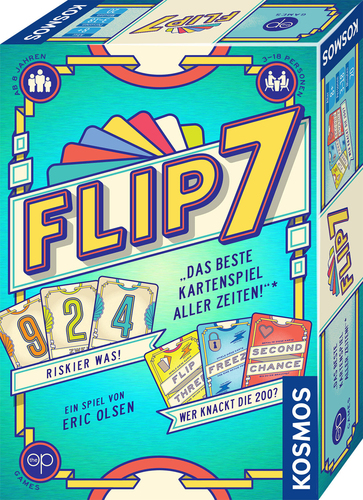
Flip 7 by Kosmos is designed, according to the publisher, for 3 to 18 players aged 8 and up and takes about 20 minutes. The idea clicks instantly: you flip number cards in front of you and collect points. Draw a number that’s already in your row and your round is over, points gone. Action and bonus cards mix things up, and the first to reach 200 points wins.
Good for: large, mixed groups where not everyone is a regular gamer. Less good for: people who like to plan ahead, since card luck plays a big part. According to Kosmos it isn’t meant for two players, and with a big group you’ll need a large table because everyone lays out their own row of cards.
Hitster: the music game for grown-up groups
Hitster by Jumbo works differently from classic card games. You scan a card’s QR code with the free Hitster app, the song starts via Spotify, and you slot the card into your timeline where you think its release year belongs. Only when you flip it over do you find out if you were right. According to Jumbo it’s for 2 to 10 players aged 16 and up, takes around 30 minutes, and also has a co-operative mode and a solo variant.
Good for: groups of friends, birthdays and anyone who likes to sing along. The box holds 308 music cards with songs spanning roughly 100 years, which often appeals across generations, even though Jumbo rates it 16+. Note that it doesn’t work without a smartphone, internet and a music streaming service. With Spotify Free, Jumbo says one person takes on the DJ role; with other services you search for the songs by hand. The edition covered here is the German one.
Family groups: kids and adults at one table
In mixed groups, what counts most is that everyone keeps up and nobody drops out frustrated. Number cards instead of text are a big plus, because younger kids can join in without help reading.
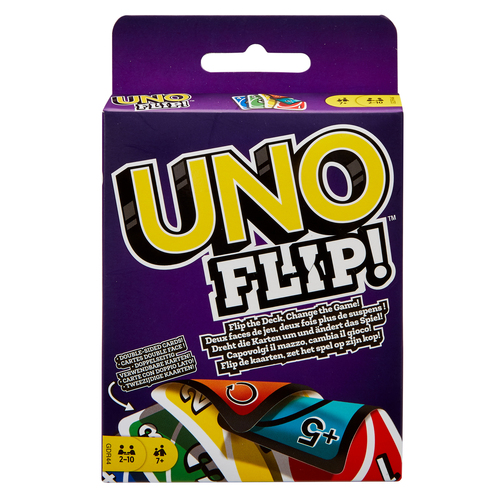
UNO Flip!: familiar rules with a twist
UNO Flip! is built on the discard principle almost everyone knows: match colour or number, shout “UNO” at your second-to-last card. The difference: every card has a light side and a dark side. When the FLIP card is played, everything turns over, and according to Mattel the dark side brings harsher cards like “Draw 5” or “Skip Everyone”. Mattel lists it for 2 to 10 players aged 7 and up.
Good for: families who already know UNO and want something new, since explaining it takes barely more than a sentence. Worth knowing: because the cards are printed on both sides, the others can see the back of your hand. That’s intentional, but it can puzzle newcomers at first.
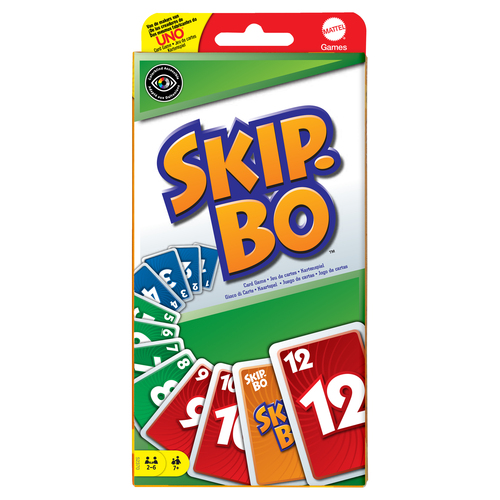
Skip-Bo: calmer, but with some brainwork
Skip-Bo is the more relaxed choice. Everyone has their own stockpile to get rid of by playing cards onto shared piles in order from 1 to 12. Skip-Bo cards act as wilds. Mattel describes it as a family patience-style game for 2 to 6 players aged 7 and up, lasting about 20 minutes.
Good for: groups with kids who count confidently to twelve, and grandparents who prefer a gentler pace. Handy: you can adjust the length by dealing smaller stockpiles. With six players and full stockpiles, though, a game can run noticeably longer.
Small groups and tacticians: two to four players
Playing with two, three or four? Then you can go for something that asks for a bit more overview. There’s little waiting between turns, and tactics matter more.
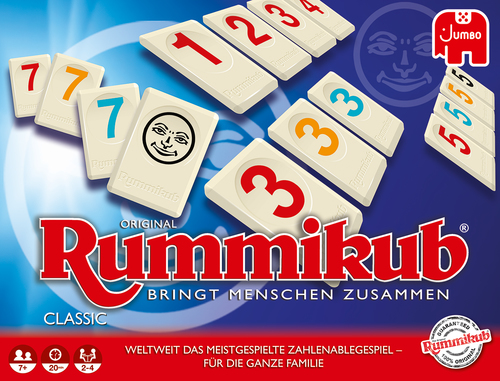
Rummikub: rearranging allowed
Rummikub by Jumbo takes the rummy principle and puts it on plastic tiles numbered 1 to 13 in four colours. You form runs or groups, and your first meld has to be worth at least 30 points. The trick: you may rearrange anything already on the table, as long as every combination is valid at the end. According to Jumbo it’s for 2 to 4 players aged 7 and up and takes around 20 minutes.
Good for: couples, small family groups and anyone who enjoys a puzzle. The rules are quick to explain, but rearranging demands more and more overview as the game goes on. One set isn’t designed for more than four players, and according to the manufacturer the small tiles aren’t suitable for children under three.
For groups who like a bit of chaos
Some groups don’t want quiet tactics at all; they want to wind each other up. There’s a category for that too.
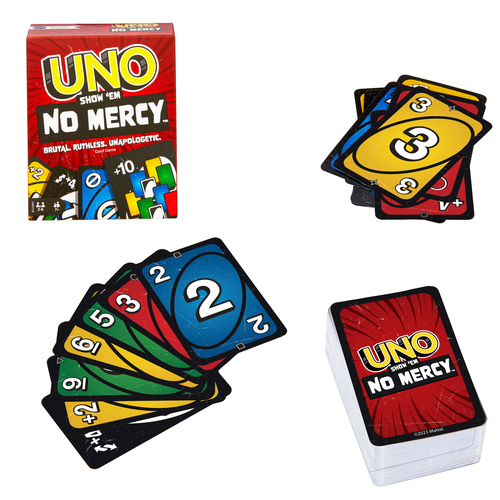
UNO Show ’em No Mercy: UNO without mercy
UNO Show ’em No Mercy is what Mattel calls the toughest UNO yet. The box holds 168 cards, including “Draw 6”, “Draw 10” and “Skip Everyone”. Draw penalties can be stacked onward, a 7 or 0 means swapping hands, and anyone who ends up with too many cards under the mercy rule (the limit is 25) is out. So you can also win by being the last one standing. Mattel’s age rating is 7 and up. The manufacturer data available to us doesn’t state a player count, so check the box for that.
Good for: groups of friends and older kids who can handle a bit of gloating. Less good for: younger children who hate losing, or quiet family evenings, since individual players can pile up cards fast or get knocked out entirely.
Quick guide: which game for which group?
| Group | Good fit | Players / age per manufacturer |
|---|---|---|
| Big group, lots of casual players | Flip 7 | 3–18, 8+ |
| Party with music, adults | Hitster | 2–10, 16+ |
| Family, everyone knows UNO | UNO Flip! | 2–10, 7+ |
| Family, calmer, with grandparents | Skip-Bo | 2–6, 7+ |
| Two to four, likes tactics | Rummikub | 2–4, 7+ |
| Friends who like to wind each other up | UNO Show ’em No Mercy | see box, 7+ |
Tips for a great game night
- Start with the easiest game. A short, quickly explained game as a warm-up puts everyone at ease. After that, things can get a little more involved.
- Read the rules once beforehand. Whoever explains should know the game. Nothing stalls an evening like everyone puzzling over the rulebook together.
- Don’t put too many boxes on the table. Two or three options are plenty. Otherwise game night turns into a debate.
- Keep an eye on the group. If someone keeps losing or getting knocked out, switch to a game where luck is spread more evenly.
- Prep the tech. For Hitster, make sure the phone is charged, the app is installed and a speaker is ready.
The lynx’s verdict
There’s no perfect game for every occasion, but there is the right one for your group. For big groups, fast games with short turns like Flip 7 are ideal; for music lovers among the adults, Hitster practically runs itself. With kids, games built on numbers rather than text score well, such as UNO Flip! or Skip-Bo. And if you like a puzzle with two to four players, Rummikub is a great fit. With two quite different games on the shelf, you’re ready for most evenings.