Buying an Air Purifier: What Really Matters
CADR, room size, HEPA, activated carbon, noise and filter changes: how to find the air purifier that fits your room and your everyday life.
This article contains affiliate links (marked with *). If you buy through them, we earn a commission – the price stays the same for you. Learn more
Pollen in spring, cat hair on the sofa, dust in a city flat: air purifiers promise cleaner indoor air. They can deliver on that, as long as the device suits the room. The spec sheets, however, are full of abbreviations and manufacturer figures that aren’t always easy to compare. The Lynx sorts out the points that matter.
What an air purifier can and can’t do
An air purifier draws in room air, pushes it through filters and blows it back out cleaned. It removes particles such as dust, pollen and pet hair, and with the right filter it can also reduce odours. What it can’t do is replace ventilation. Fresh air only comes in through the window, and humidity stays in the room.
A word on allergies: an air purifier can reduce the load in the air you breathe indoors, but it isn’t a treatment. If you have health complaints, the question of what helps you belongs with a doctor.
CADR: the most important number on the spec sheet
CADR stands for Clean Air Delivery Rate. It tells you how much cleaned air a device delivers per hour, usually in cubic metres per hour (m³/h). The higher the value, the faster a room is filtered. Check which particles the figure refers to; some manufacturers also list a separate CADR for gases.
Here’s how to do the maths yourself:
- Room volume: floor area × ceiling height. 20 m² with a 2.5 m ceiling gives 50 m³.
- Air changes per hour: CADR ÷ room volume. A device rated at 250 m³/h would manage 5 air changes per hour in that room.
The more often the air passes through the filter each hour, the faster the particle load drops. Several air changes per hour are commonly recommended for pollen and allergens, so some headroom is a good idea.
Room size: reading manufacturer figures correctly
The square-metre figure on the box is handy, but take it with a pinch of salt. Manufacturers calculate differently, and the maximum room size often refers to the highest fan speed, which hardly anyone runs all day because it’s the loudest. Rule of thumb: pick a device rated noticeably above your actual room size. Then it can do the job on a quiet setting too.
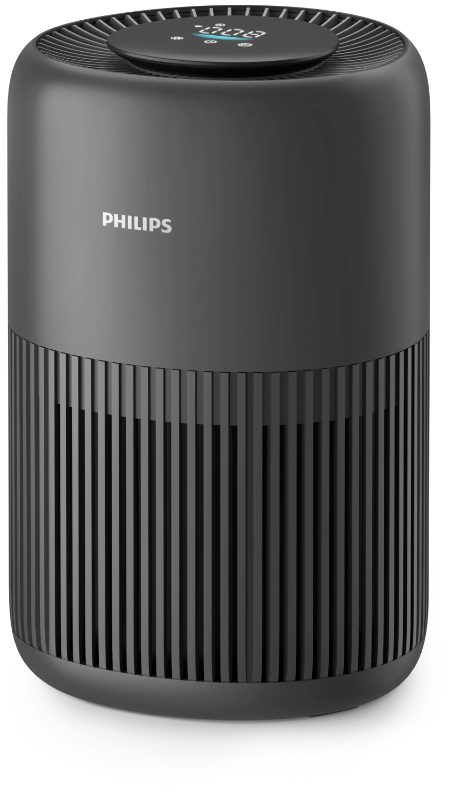
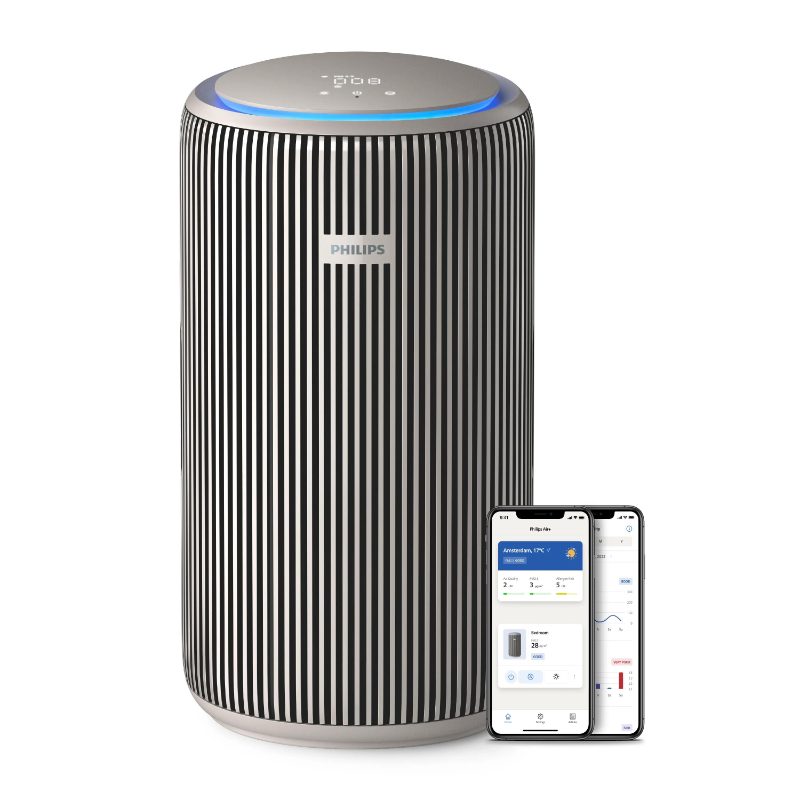
An example of a clear figure: for the Philips PureProtect 3200, Philips states that a 20 m² room is filtered once in under six minutes. Philips rates the PureProtect Mini 900 for rooms up to 65 m².
Filters: HEPA, activated carbon and pre-filter
Most devices work in several stages:
| Filter stage | What it does |
|---|---|
| Pre-filter | catches coarse stuff like hair, lint and larger dust |
| HEPA filter | captures fine particles such as pollen, fine dust and pet allergens |
| Activated carbon | absorbs odours and certain gases |
HEPA deserves a closer look. True HEPA filters are graded under the EN 1822 standard into classes such as H13 or H14. Terms like “HEPA-type” or “HEPA-like” aren’t a protected class. If filter performance matters to you, check whether the manufacturer states a class or a specific filtration efficiency. According to Philips, both devices use a pre-filter, a NanoProtect HEPA filter that captures particles down to 0.003 microns, and an activated carbon layer.
Activated carbon makes sense if cooking smells, pet odour or smoke from outside bother you. For pure pollen problems, the particle filter is what counts. Steer clear of devices that produce ozone; ozone irritates the airways.
Noise: sleep mode matters
Ideally an air purifier runs continuously, including while you watch TV, work or sleep. That makes noise a key criterion. Decibels are logarithmic: we perceive 10 dB more as roughly twice as loud. Look at the figures for the lowest setting and sleep mode, but also for a medium setting where the device actually does some work.
According to Philips, the PureProtect 3200 runs at around 15 dB in sleep mode and about 47.5 dB in turbo mode. The Mini 900 reaches 20.5 dB in sleep mode and dims its display.
Sensors, auto mode and app
An air quality sensor measures the particle load and adjusts the fan speed in auto mode. That’s more convenient than tweaking it by hand and keeps the device quiet when the air is fine. According to Philips, the Mini 900 uses a PM2.5 sensor, while the 3200 has the AeraSense sensor with a colour indicator on the device.
An app isn’t essential, but it’s useful: you can see the air quality history, set schedules and get a reminder when the filter is due. On the 3200 that’s handled by the Philips Air+ app, including routines that clean the air before bedtime, for example.
Running costs: plan for filter changes
Filters are consumables. How often you need to change them depends on usage and air quality; roughly once a year is often given as a guide. Many devices show when a change is due on the display or in the app. Before you buy, check that replacement filters for the model are readily available and what they cost. On many devices you can clean the pre-filter in between, which is especially worthwhile with pets. Also think about power use in continuous operation: Philips states a maximum of 23 watts for the Mini 900, and less on lower settings.
When an air purifier makes sense
- Pollen season: If you have to sleep with the window closed, a device in the bedroom can lower the pollen load in the indoor air.
- Pets: The pre-filter and HEPA pull hair and allergens out of the air, activated carbon helps with odours.
- City living and busy roads: Fine dust that comes in when you air the room gets filtered out again afterwards.
- Less useful: against mould on the wall or excessive humidity. That calls for tackling the cause, plus ventilating and heating.
Small room such as a bedroom or nursery? A compact device like the Mini 900 is usually enough. For living rooms or open-plan spaces, a larger model like the 3200 with more headroom is the better choice.
Checklist before you buy
- Room volume calculated and CADR chosen with headroom
- True HEPA filter with a stated class or efficiency
- Activated carbon if odours are an issue
- Noise checked in sleep mode and at medium speed
- Display can be switched off for the bedroom
- Replacement filters available and change interval known
- No ozone-based cleaning
- Space with free air intake and outlet
The Lynx’s tip: place the device in the open, keep doors and windows closed while it runs, and let it run quietly around the clock rather than briefly at full blast.