Stainless Steel or Non-Stick: Which Pan for What?
Steak, fried eggs, salmon: when an uncoated stainless steel pan wins, when non-stick is the better choice, how to preheat properly and how long a coating lasts.
This article contains affiliate links (marked with *). If you buy through them, we earn a commission – the price stays the same for you. Learn more
The steak turns grey instead of brown, the fried egg welds itself to the pan, and the fish falls apart when you flip it. Most of the time that’s not the cook’s fault, it’s the wrong pan for the job or the wrong temperature. The good news: two types of pan cover almost everything a normal kitchen needs. Let the lynx explain which pan is good for what and how to treat each one.
The core difference in one sentence
An uncoated stainless steel pan handles high heat, metal spatulas and the dishwasher, but takes a bit of technique to stop food sticking. A non-stick pan is forgiving and releases delicate food cleanly, but doesn’t like extreme heat or scratches, and its coating wears out over time.
Neither one is “better”. They are tools for different tasks.
Searing: where stainless steel shines
If you want browning, meaning a proper crust on steak, schnitzel, chicken thighs or fried potatoes, you need high temperatures. Stainless steel has no problem with that. There’s no layer that can suffer from the heat.
There’s a bonus, too: the bits stuck to the bottom of the pan aren’t a mistake, they’re flavour. A splash of wine, stock or water loosens this fond and gives you the base for a sauce. In a non-stick pan it barely forms, because nothing is supposed to stick.
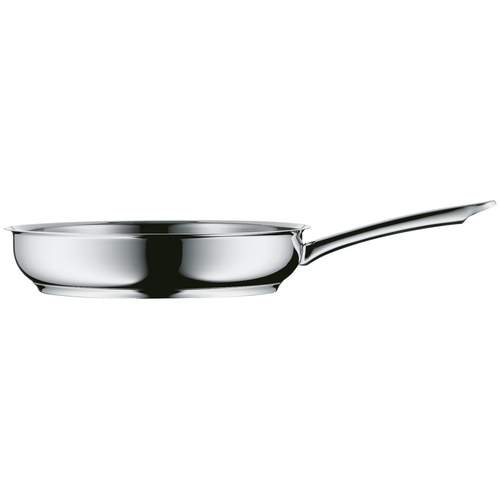
One example of this type is the WMF Profi frying pan 28 cm. According to the manufacturer it’s made entirely of Cromargan, WMF’s polished 18/10 stainless steel, handle included. At 28 cm across it fits several steaks or a big batch of fried potatoes without piling food on top of each other. That matters more than it sounds: overcrowd the pan and the temperature drops, moisture comes out and the meat steams rather than sears.
Handy: WMF rates the pan as oven-safe up to 250 °C. So you can sear a thick piece of meat on the hob and finish it in the oven without switching pans. No lid is included.
Eggs, fish, pancakes: non-stick territory
Egg white is sticky. Fried eggs, scrambled eggs, omelettes, pancakes and delicate fish with the skin on love to bond with the pan, especially at the medium heat that suits these dishes. In stainless steel it’s doable with practice and enough fat, but a non-stick coating makes it far more relaxed. The egg slides, the fish flips, and you need less fat.
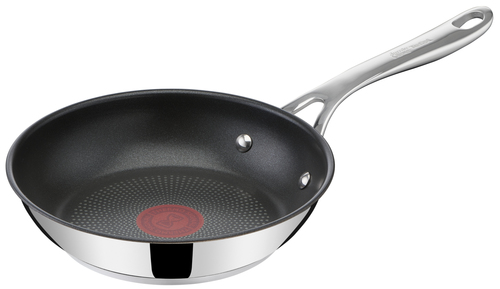
This is where the Tefal Jamie Oliver Cook’s Direct On 20 cm fits. It has a stainless steel body and, according to Tefal, a titanium-reinforced non-stick coating inside, PFOA-free per the manufacturer. At 20 cm it’s on the small side: ideal for one or two eggs, an omelette, a portion of vegetables or toasting nuts and spices. For family portions it’s too small; go for 24 to 28 cm instead.
A special feature is the Thermo-Signal in the centre. According to Tefal, the spot changes colour once the pan reaches roughly 140 to 195 °C. That helps with preheating, which is exactly where most mistakes happen.
Preheating and “seasoning” the right way
Stainless steel: patience before the fat
The most common reason everything sticks in stainless steel: the pan wasn’t hot enough. Here’s how to do it better:
- Preheat the pan without fat on medium to high heat for a few minutes.
- Do the water drop test: flick a few drops of water into the pan. If they just hiss and evaporate, it’s still too cool. If they form beads that dance across the surface, the pan is ready.
- Wipe away or let the drops evaporate, then add an oil with a high smoke point and let it warm briefly.
- Add food that’s as dry as possible and don’t move it straight away. Meat sticks at first and releases on its own once the crust has formed.
Stainless steel doesn’t need the kind of seasoning you do with iron or cast iron pans, where a patina builds up. When people talk about “seasoning” stainless steel, they usually just mean preheating it properly.
Non-stick: a gentler start
Don’t leave a non-stick pan empty on the highest setting. Preheat it on medium with a little fat, and with the Tefal use the Thermo-Signal as a guide. Then you can turn the heat down. Before first use, many manufacturers recommend washing and drying the pan and rubbing the surface with a little oil. Follow the instructions for your specific pan.
Induction: both work, but check the spec
An induction hob generates heat directly in the base of the pan. That only works if the base is magnetic. Not every stainless steel is automatically, so check the manufacturer’s information or hold a magnet to the base.
According to the manufacturers, both example pans work on all common hob types, including induction, gas, ceramic, halogen and electric. One tip for induction: the zones heat up very quickly. Non-stick pans in particular reach high temperatures in no time if you leave them empty on full power. Better to start on medium.
Also watch the size: the base of the pan should roughly match the cooking zone. A small 20 cm pan on a large zone, or the other way round, heats unevenly.
Care: tough versus delicate
Stainless steel
According to WMF the pan is dishwasher-safe, and metal spatulas are no problem. For stubborn residue, it’s best to soak it with a little water while the pan is still warm. Rainbow or brownish heat tints are normal on stainless steel and don’t affect how it works. If they bother you, stainless steel cleaner or a splash of vinegar helps.
Remember: a stainless steel handle gets hot during long frying sessions and in the oven. Keep an oven glove handy.
Non-stick
Here, care decides how long the pan lasts:
- Wooden, silicone or plastic utensils instead of metal.
- Hand washing with a soft sponge. Tefal says the pan is dishwasher-safe but recommends hand washing because it’s gentler on the coating.
- No abrasive cleaners, no steel wool.
- Don’t stack without protection, or the base of the next pan will scratch the coating.
- Don’t overheat: empty on full power is the fastest way to age a coating. In the oven, Tefal specifies a maximum of 210 °C for this model.
How long does a non-stick coating last?
Honest answer: it depends heavily on how you use the pan. A fixed number of years can’t be given with any credibility. The coating is a wear part, and heat, scratches and harsh cleaning speed up wear considerably.
Typical signs it’s time for a new pan:
- Eggs and pancakes stick even though you preheat as usual and use a little fat.
- The surface is visibly scratched or flaking in places.
- The pan has warped and no longer sits flat on the hob.
That’s exactly why the combination makes sense: if you always do high-heat searing in the stainless steel pan, the non-stick pan only gets the gentle jobs and lasts accordingly longer. An uncoated stainless steel pan doesn’t have this wear problem at all.
The lynx’s quick guide
| What you’re cooking | Better choice |
|---|---|
| Steak, schnitzel, crispy fried potatoes | Stainless steel, uncoated |
| Pan sauce from the fond | Stainless steel, uncoated |
| Sear on the hob, finish in the oven | Stainless steel (up to 250 °C per WMF) |
| Fried eggs, scrambled eggs, omelette | Non-stick |
| Pancakes, crêpes | Non-stick |
| Delicate fish, especially skin-on | Non-stick (or stainless with practice) |
| Cooking with little fat | Non-stick |
| Dishwasher and metal utensils | Stainless steel |
Mostly cooking for one or two and frying eggs a lot? Then a small non-stick pan like the Tefal 20 cm is the one you’ll reach for every day.
Love searing meat or cooking for several people? Then a large stainless steel pan like the WMF 28 cm is worth it: it handles the heat and stays in service for years.
Want both? Then a large stainless steel pan plus a small non-stick pan is the most sensible basic setup for most kitchens.
The lynx’s verdict
Stainless steel for heat and crust, non-stick for anything delicate. Preheat stainless steel patiently until water drops dance, and treat the non-stick pan gently: medium heat, no metal, ideally washed by hand. Split the jobs that way and you’ll have less trouble at the stove and need to replace the non-stick pan less often.